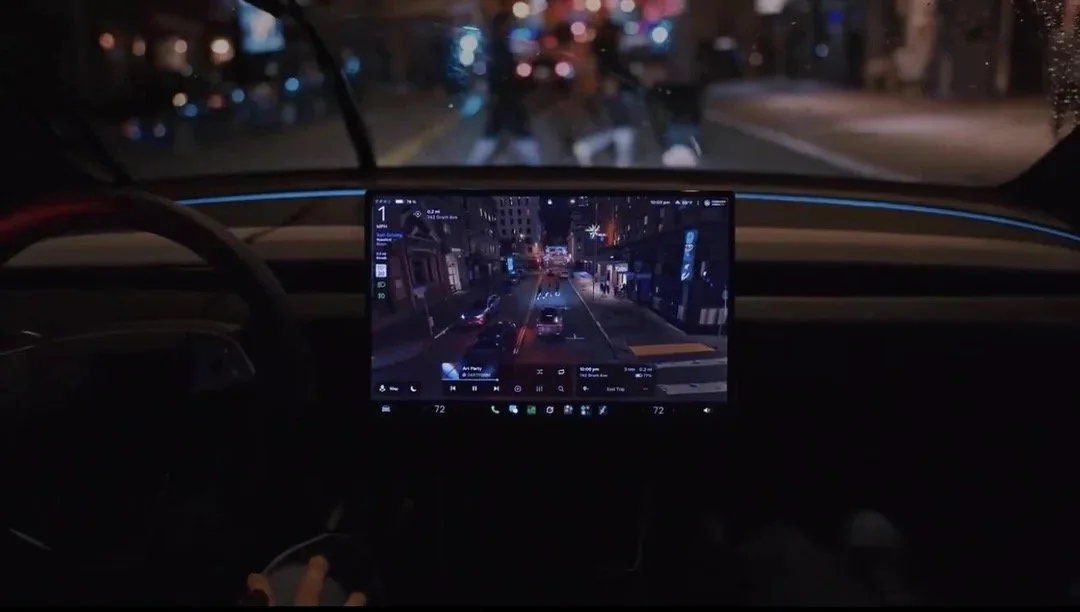
Tesla Reality View in FSD (Supervised) v15. Image: Tesla.
I don’t usually write about cars here. But every so often a piece of technology solves a problem so cleanly that I can’t stop thinking about it. Tesla’s FSD v15 update could be one of those. It’s early, and I’ll be curious to see how it holds up, but it looks promising.
Tesla started rolling out FSD (Supervised) v15.0.1, in software update 2026.38.6.11, to early-access drivers today, and a wider release is planned for December. The headline change is what Tesla calls Reality View: a live view of the road around the car, shown on screen as if from a camera floating just above it. That sounds like a fresh coat of paint, but the interesting part is what's underneath.
From many pieces to one
Until now, the on-screen display was built from several separate parts. One spotted cars and people, another drew lane lines, another mapped open space, and each was hand-engineered and layered on top of the others. It worked, but it was a patchwork.
In Tesla's words, Reality View replaces "all of the explicit model signals" with "a single end-to-end visualization." The picture now comes from the same driving model that's actually steering the car. So what you see isn't a separate guess at what the car is thinking. It's what the car is thinking.
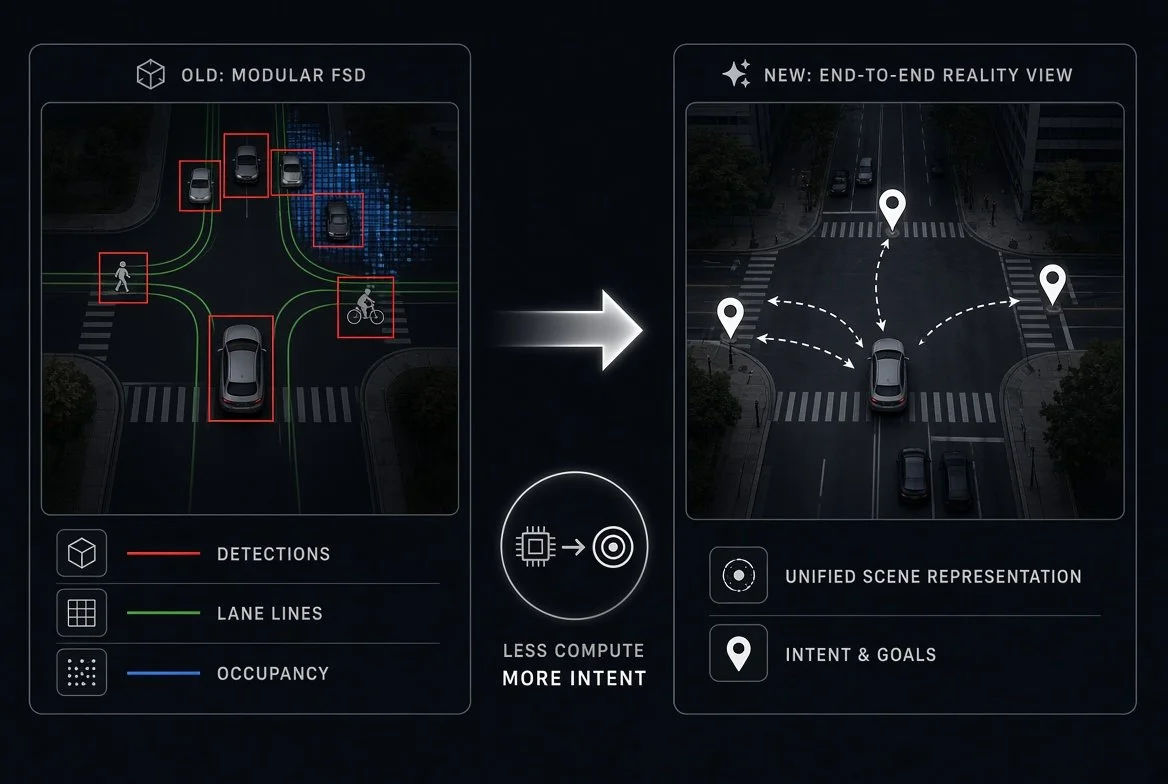
Illustrative diagram: the old layered overlays versus one unified view.
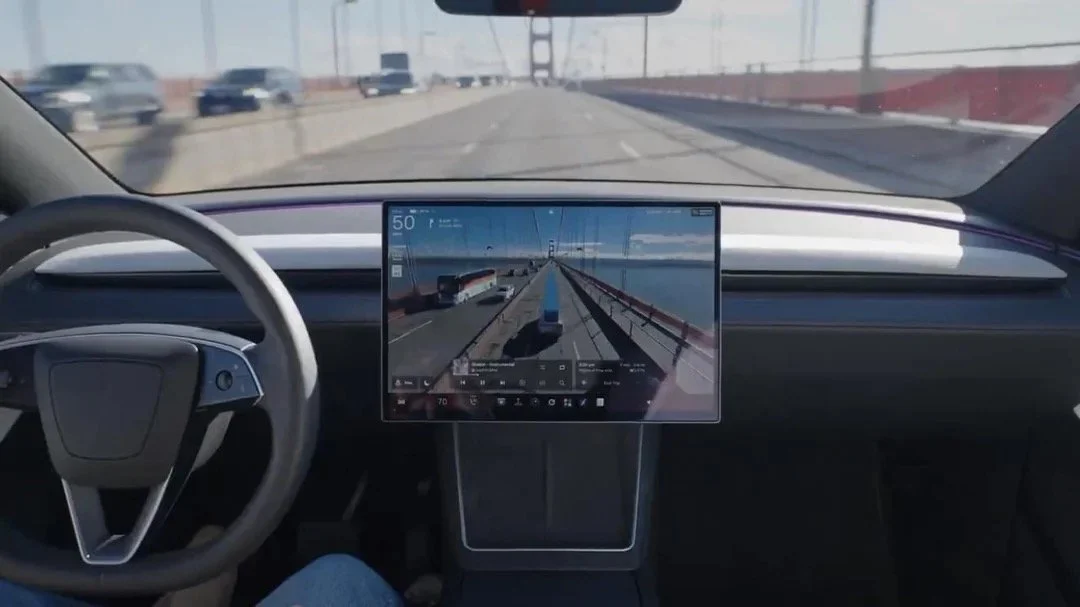
Reality View on the Golden Gate Bridge. Image: Tesla.
More detail, less computing power
This is the part I find most elegant. You'd expect a richer, unified view to need more computing power. According to Tesla, it uses less total compute, and Ashok Elluswamy, who leads Tesla's self-driving software, has said the new view is more efficient than the old setup. Simpler under the hood, better on screen. That's a rare combination.
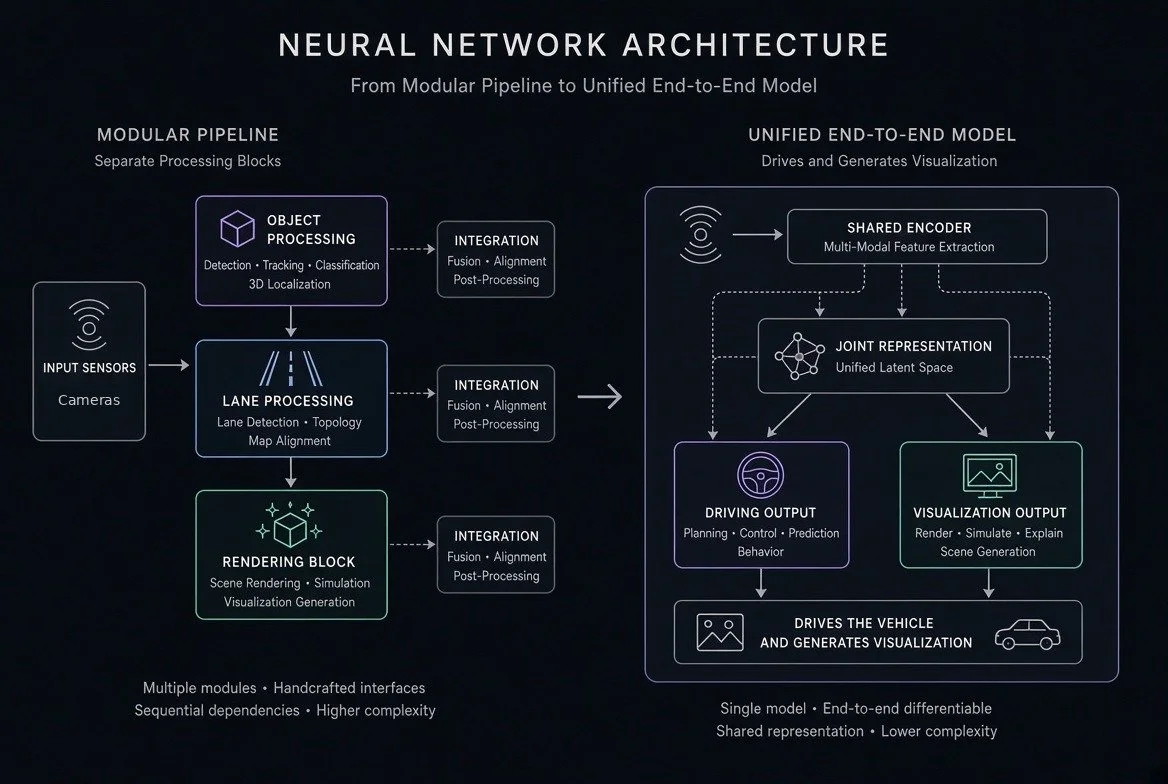
Illustrative diagram: separate processing blocks versus one model that both drives and generates the view.
Showing where it's headed
Reality View is also better at showing what the car plans to do next. Arrows mark upcoming turns, pins mark parking spots, and the planned path is drawn out. You can even tap a spot on the screen to send the car there. It isn't just showing you the world anymore. It's telling you its plan.
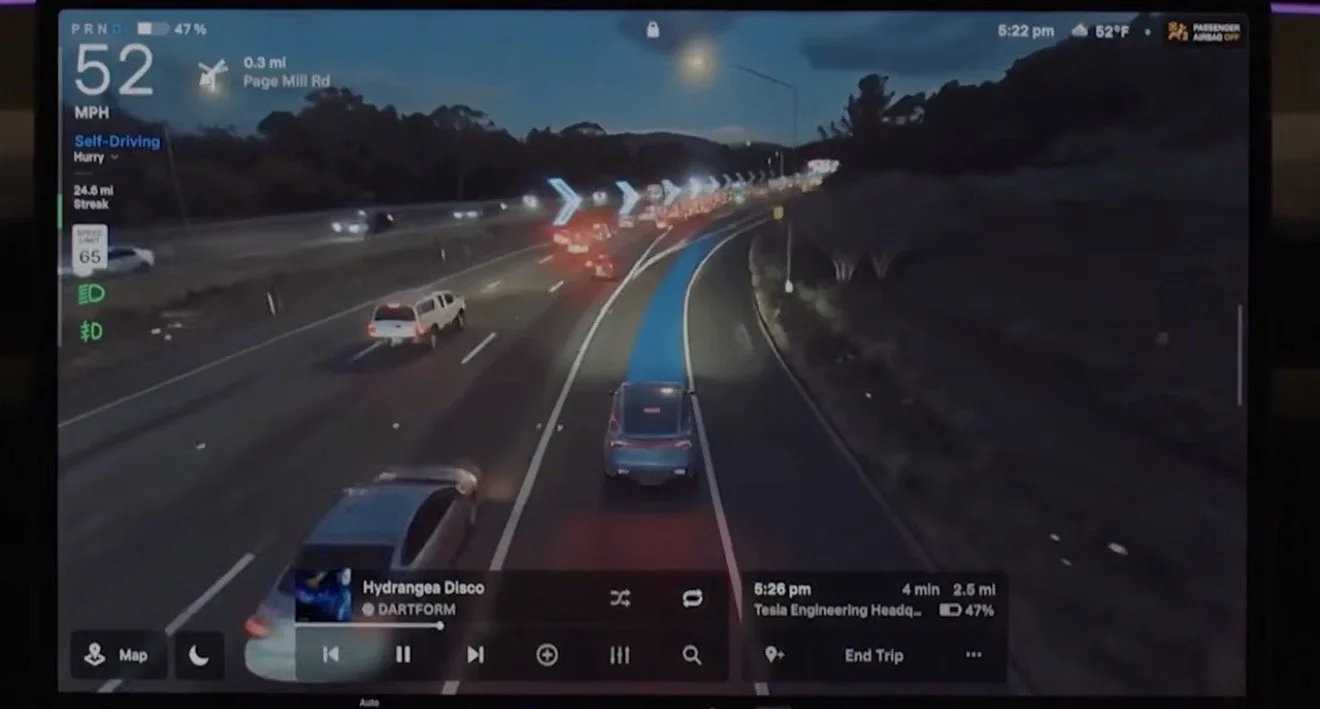
Arrows and a highlighted path show the car’s planned route. Image: Tesla.
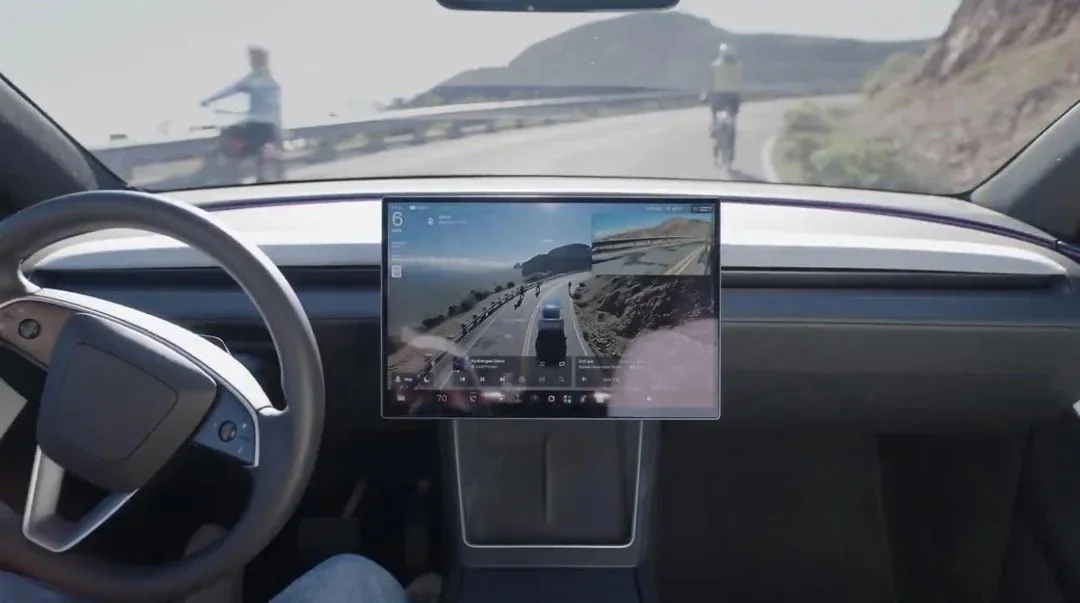
Cyclists ahead, rendered in Reality View. Image: Tesla.
The bigger engine behind it
Tesla says v15 upgrades every part of its end-to-end driving network. At the center is an upgraded vision encoder shared between FSD, Robotaxi, and the Optimus robot, trained on millions of internet videos. Tesla credits it with improving the critical intervention rate by 25x, meaning far fewer moments when a driver has to step in. The notes also list better detection of road signs, small animals, debris and potholes, avoidance of deep standing water, more natural speed handling in school zones and bad weather, and smarter parking suggestions based on your own history.
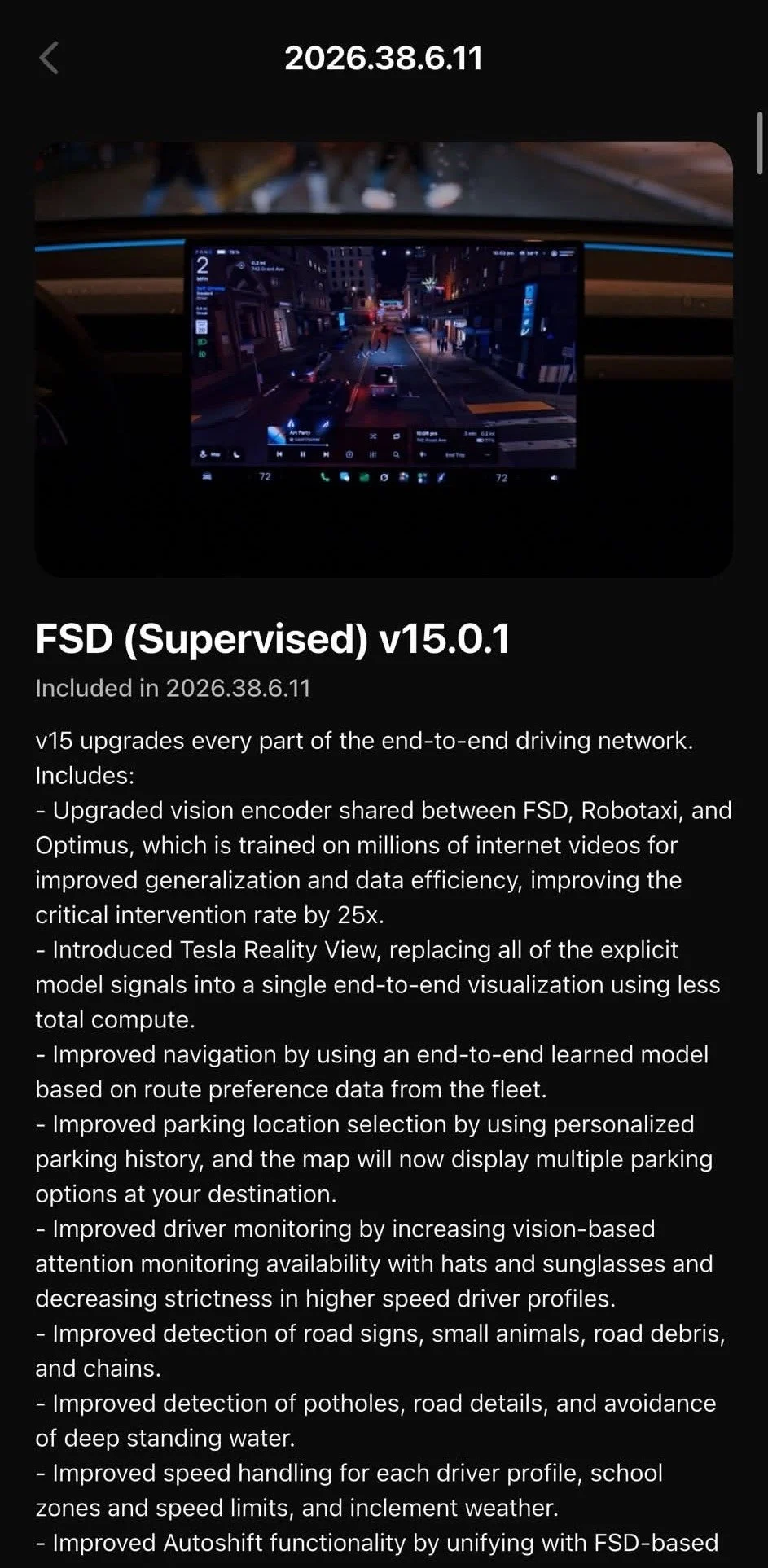
From Tesla's official FSD (Supervised) v15.0.1 release notes.
Why it stuck with me
I'm not an engineer, and I won't pretend to know the inner workings. What caught my attention is the principle. In my work, the best videos are the ones where the picture and the purpose are the same thing. The viewer sees exactly what the story means, with nothing lost along the way. Reality View does that for a car: one source of truth, shown clearly and simply, without the extra layers.
That's worth noticing, whatever field you're in.